Categories
NFL General

Dec 8 in Sports History: Bears beat Redskins 73-0 in Championship game

In 1940: If you thought the Buffalo Bills were pathetic in Super Bowls, how about the Washington Redskins’ showing in the 1940 NFL Championship game against the Chicago Bears? Having defeated the Bears 7-3 a few weeks ago in a rough, physical game, the Redskins called the Bears “crybabies.” Uh, big mistake to piss off George Halas, the Bears legendary coach. The Bears completely redesigned their offense, having a college coach come in and teach them the T formation. It worked pretty well, as the Bears scored 28 points in the first quarter, and ran up the score to a whopping 73-0. It still remains as the most lopsided game in NFL history. Also, to add to the humiliation for the Redskins, sports fans across the country followed the Bears 11 touchdowns (including three interception returns in the third quarter) in the first national broadcast of an NFL game on radio. We’re not sure if Halas’ tombstone reads, “Who’s Crying Now, Bitches!” (The 2006 ESPN Pro Football Encyclopedia).

In 1987: Ron Hextall of the Philadelphia Flyers became the first goaltender to shoot and score a goal in an NHL game. Billy Smith of the Islanders received credit for a goal as the last player to have possession of the puck when an opponent accidentally put it into his own net and Bob Froese of the Flyers was originally thought to have scored, but the goal was later changed. At the end of a game against Boston, Hextall got possession of the puck at the goal line and flipped it the length of the ice into the empty net. Hextall would score again a few years later in a playoff game against the Washington Capitals. Since then, Martin Brodeur, Chris Osgood and Jose Theodore have scored empty-netters. (everything2.com)

(Oh, and don’t believe anybody who tells you that I once let up a goal on a shot by the other goalie in gym class in sixth grade)

Categories
College Football

A trip down Heisman Memory Lane


Young Vinny Testeverde

In 1939: Nile Kinnick, a halfback from Iowa won the fifth Heisman trophy award given to college football’s most outstanding player. Kinnick never turned pro and instead joined the fight in World War II. He died in 1943 when his fighter plane crashed into the Caribbean Sea.

In 1961: Ernie Davis of Syracuse won the second-closest vote in Heisman history, edging out Ohio State’s Bob Ferguson. Sadly, like Kinnick, Davis died shortly after winning the Heisman. He was the top draft pick of the Cleveland Browns, but was stricken with leukemia just a few games into his rookie season. He was the first African-American player to win the Heisman Trophy.

In 1975: Archie Griffin of Ohio State became the only player in history to win back-to-back Heisman Trophies. Griffin combined power and speed to amass over 5,000 total yards while playing for the Buckeyes. He was drafted by the Cincinnati Bengals, and although he never was the superstar he was in Columbus, he had a solid career.

In 1986: Miami quarterback Vinny Testaverde won the 52nd Heisman, lapping the likes of Paul Palmer, Jim Harbaugh and Gordon Lockbaum (of Holy Cross, who finished 5th) with the fifth-largest margin of victory in the history of the voting. Testaverde still leads all Hurricane passers with 46 career touchdowns. He went from being a monumental first round bust with the Tampa Bay Buccaneers to having a decent career with the Browns/Ravens, Jets (teams he led to the playoffs) and Cowboys. He is currently the backup in New England.

(All info and stats coutesy of heisman.com)

Categories
Video Games

Dec 5 in Sports History: Dad, what’s a video arcade?


In 1983: As a very prehistoric precursor to the John Madden video game franchise, the NFL introduced its first video arcade game, the creatively titled “NFL Football.” Madden it sure as heck wasn’’t, as there were very few features. In fact, the game’s creators were banking that the kids pumping their quarters in didn’’t mind being the Raiders and the Chargers all the time, because that’s all they were getting. After the play was selected, it showed the play using actual footage from a real NFL game between those two teams. Also, there was no dynasty mode or anything cool (like you could be Marcus Allen and bang OJ Simpson’s wife or Dan Fouts and be really fucking annoying on the air). Unfortunately, the game didn’’t do very well (there was a second edition with Redskins-Cowboys) and production was halted in 1984. (www.klov.com)

In 1981: Speaking of Marcus Allen, football’s most beloved adulterer won the Heisman Trophy as a tailback at USC, edging out Georgia sophomore Herschel Walker in a close vote. Allen was the fourth USC running back to win the Heisman (hey, OJ won one too…Maybe you own it!) but was the only Trojan to rush for over 2,000 yards in a season. He was also the first player to run for over 200 yards in four straight games. Allen was drafted by the Raiders in 1982, and he went on to have a hall of fame career and won a Super Bowl MVP in 1984.

In 1982: Herschel Walker finally got his due by winning the Heisman Trophy as a junior, easily outdistancing Stanford‘s John Elway (Dan Marino finished 9th, way behind Tony Eason). Many felt that Walker should have won in his freshman year, when he ran for over 1,600 yards, 15 touchdowns and outclassed George Rogers, South Carolina’s Heisman winner that year, in a key Bulldog’s victory. Only a bias against underclassmen kept Walker from possibly winning an unprecedented three straight awards. Had Walker stayed in Athens for his senior year, he probably would still hold all Division I-A rushing records, as he had over 5,000 yards and 50 career touchdowns with a whopping 5.3 yards per carry in only three seasons. He decided it would be a better idea to try and commit career suicide, however, and he went to the USFL’s New Jersey Generals for three years. (heisman.com)

Categories
Golden State Warriors

Nov 4 in Sports History: Latrell Sprewell chokes PJ Carlesimo


Damn I’d like to choke him again

In 1997: Latrell Sprewell of the Golden State Warriors was suspended for one year by the NBA for assaulting his coach, PJ Carlesimo. During a practice, Carlesimo supposedly criticized Sprewell’s passing, and after Carlesimo confronted him, Sprewell choked his head coach until he was pulled off by teammates. He later came back to practice and took a swing at Carlesimo. Not only was Sprewell suspended, but he was cut by the Warriors and his contract of four years, $32 million (that he had just signed in the offseason) was terminated. The suspension would later be reduced to 68 games (remember, he had a family to feed). Sprewell would not play a game (due to the lockout the following year) until he became a member of the New York Knicks in February of 1999. (nba.com/player file/Sprewell)

In 1968: Due to a lack of offense in Major League Baseball, the Rules Committee lowered the pitcher’s mound from 15 inches to 10 inches and the strike zone was modified from shoulders-to-knees to armpits-to-knees. In the “Year of the Pitcher,” the league batting average dipped to a paltry .236, runs scored per game were just 3.4, only three players drove in more than 100 runs, Bob Gibson of the Cardinals had a 1.12 ERA, Denny McLain won 30 games for the Tigers, and Don Drysdale of Los Angeles set a record by pitching 58.2 consecutive scoreless innings. The following year–aided by expansion, as well–saw the overall batting average increase by 20 points and scoring increased by 20 percent. (baseball-almanac.com, The Baseball Encyclopedia).

In 1956: Wilt Chamberlain made his college basketball debut for the University of Kansas as a sophomore (the rules at the time prohibited freshman from playing on the varsity). If you thought Greg Oden, the Ohio State phenom, was impressive in his debut on Saturday (14 points, 10 rebounds, 5 assists), get a load of Wilt‘s numbers. He scored 52 points and grabbed 31 rebounds in a win over Northwestern. He would go on to average 30 points and 20 rebounds in his career at Kansas, and he led the Jayhawks to the 1957 NCAA title game. He also won the high jump at the Big Seven (the conference which precluded the Big 8 and Big 12) Track and Field Championships. No word on how far along the number of women (of the 20,000) the “Big Dipper”’s odometer was at this time. (www.kuconnection.org)

Categories
NBA General

Dec 1 in Sports History: Basketball is invented


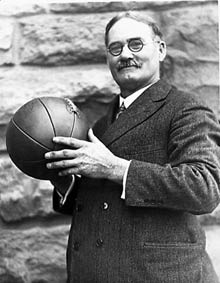
In 1891: The object of the game is to put the ball in your opponents goal (a peach basket at first). This may be done by throwing the ball from any part of the grounds, with one or two hands.

This simple idea was originated by Dr. James Naismith, a Canadian physical education teacher, to provide an “athletic distraction” to a group of bored teenagers during a brutal winter in Springfield, MA. “Basket ball” grew into one of the world’s most popular sports, with 300 million people playing around the globe today (not counting RJ’s sweet shot of a ball of tape into a trash can via a co-worker’s back that he totally meant to do). Naismith laid out 13 simple rules, which banned traveling (which is yet to be adopted by the NBA), dribbling (players had to shoot or pass when catching the ball), and included the five second inbounding rule and no goaltending. Naismith died on Nov. 28, 1939, almost 40 years to the day he invented basketball. He was enshrined in the Basketball Hall of Fame (which adorns his name) in 1959. (hoophall.com)

In 1993: The Houston Rockets proved they were pretty good at Naismith’s invention by defeating the Knicks at Madison Square Garden 94-85, to win their 15th game in a row to start a season, tying an NBA record. Led by MVP Hakeem Olajuwon, the “Clutch City” Rockets won 22 out of their first 23 games and later beat the Knicks again to win their first of back-to-back NBA titles. (basketball-reference.com)

In 1967 Wilt Chamberlain of the Philadelphia 76ers proved that he wasn’t so good at Naismith’s invention on this day as he set a record for missing 22 free throws in a 138-130 win over the Los Angeles Lakers. Of course, we’re kidding about the not-so-good part, but foul shooting was an Achilles heel of the Stilt’s, as he shot only 51 percent from the line for his career (opponents originated the “Hack-a-Shaq” strategy on Wilt). (nba.com/history)

Categories
General Sports

Nov 30 in Sports History: Brian’s Song


In 1971: ABC-TV aired “Brian’s Song,“ one of the most famous sports movies ever. The movie was a tearjerker about Brian Piccolo (played by James Caan) and Gayle Sayers (Billy Dee Williams), two Chicago Bears teammates who, despite their differences, became best friends, blah, blah, blah. Piccolo ends up dying of cancer, and we didn’t cry, there was just a lot of dust everywhere that day. (imdb.com)

In 1996: In a win over the Spurs, Michael Jordan of the Bulls scored 35 points and recorded his 25,000th career point. Jordan finished his 15-year career with over 32,000 points and a 30.1 average. Jordan was only the tenth player in NBA history to hit the quarter-century mark in points scored. (basketball-reference.com)

In 2005: The Boston Bruins made one of the worst trades in sports history, as they jettisoned captain, former top draft pick and franchise player Joe Thornton to the San Jose Sharks for Marco Sturm, Wayne Primeau (not Keith, the better of the two brothers) and Brad Stuart. The Bruins immediately went into the tank, missed the playoffs and GM Mike O’Connell was fired, while Thornton flourished with the Sharks. He teamed up with Jonathan Cheechoo to lead the league in scoring and also won the Hart Trophy as the league’s MVP. (nhl.com)

Categories
College Football

Sports History: Thanksgiving Leftovers edition

Thanksgiving weekend is one of the best and most extended sports weekends of the year. Four full days of food, football, family, more football and more food, sprinkled with plenty of basketball (college and pro) and a dash of hockey make for a grand feast of sports gluttony not matched until the middle of March (some say Bowl Season, but we here at Sportscolumn blog are against whatever Shit Bag bowl 6-6 Pitt is going to be invited to, so no). Since we were so busy over the weekend ingesting all of this, and the Monday after is always one of the slowest days, not much happens (unless you count the dominance that is Hunters vs. Bears). So we offer you a healthy cornucopia (I love that word and this is the only time of year I can use it, so shoo) of sports history leftovers. Enjoy!

On November 23, 1984: In one of the most remarkable college football plays ever, Doug Flutie hit receiver Gerard Phelan with a “Hail Mary” pass with no time on the clock to help Boston College upset defending national champion Miami at the Orange Bowl, 47-45. After the Hurricanes took the lead 45-41 on a Melvin Bratton touchdown with 28 seconds remaining, the Eagles got the ball to the Miami 48 with six seconds left. On the last play, Flutie scrambled right and heaved the ball towards a cluster of players near the goal line. The ball miraculously eluded the outstretched hands of Hurricane defenders and found Phelan, who cradled it “like a newborn baby” as he fell into the end zone with zeroes on the clock. Flutie’s miracle pass capped off an amazing Heisman Trophy campaign for the diminutive QB from Natick, MA. He ended up with 472 yards passing that day, using the Hail Mary to edge Bernie Kosar’s 445 yards in the air.  (espn.com)

On Nov. 24, 1960: Here’s an amazing feat in NBA history that will never be duplicated: Wilt Chamberlain pulled down 55 rebounds in a game (Feel free to insert your joke here about the 20,000 women being a better record). Which undersized wusshole did Chamberlain dominate to set a record which still stands today? It was only his chief rival and nemesis, hall of famer Bill Russell of the Boston Celtics. The game was a microcosm of the two center’s careers, as Chamberlain dominated on the stat sheet (he added 34 points and four assists), while Russell and the Celtics won the game, 132-129. We also know that Chamberlain’s 100 points in a game seems unattainable, but we’re pretty sure Kobe will huck up 150 shots one of these days to challenge it. (www.hoophall.com)

On Nov. 26, 1990: The Houston Oilers defeated the Buffalo Bills 27-24 in a Monday Night matchup. The Bills’ loss capped off a weekend in which all six first-place teams lost in the same week, the latest ever occurrence in a season. The Bengals fell into a tie for first with Pittsburgh and Houston in the AFC Central after being upset by the Colts 34-20, the Chiefs inched to within a game in the AFC West by beating the Raiders 27-24, the Giants lost to Philadelphia 31-13 in the NFC East, the Bears were clobbered by Minnesota 41-13 in the Central, and in the NFC West, the 49ers were shocked by the Rams at home, 28-17.  Each team held on to win their division, however. Also, the losses by the Giants and 49ers took a little luster off a showdown against each other the following week in which both teams would’ve been undefeated had they not lost. (The 2006 ESPN Pro Football Encyclopedia)

Categories
College Football

Nov 14 in Sports History: Marshall football tragedy


In 1970: Returning from a game against East Carolina, 37 members of the Marshall football team, coaches and boosters were killed in a plane crash two miles outside of the Tri-State Airport in Huntington, WV. 75 people died in the Southern Airlines crash, of which the cause was never officially determined. The team was reformed for the 1971 season, and over the last decade has been re-born as a powerhouse in college football. A movie about the crash and the aftermath called “We Are Marshall” is set to be released on December 22. Check out bsd’s story on a touching tribute by East Carolina University.

In 1993: Miami Dolphins head coach Don Shula became the winningest coach in NFL history with his 325th career victory, a 19-14 win in Philadelphia. Shula coached 33 seasons with the Baltimore Colts and Dolphins and compiled a 347-173-6 record (including playoffs) with two Super Bowl titles (including a perfect 17-0 season in 1972). He retired after the 1995 season (in which a Shula-coached team made the playoffs for the 20th time) and was inducted into the Pro Football Hall of Fame in 1997.

Categories
College Football

Nov 13 in Sports History: College Football’s Game of the Century


In 1993: In a college football “Game of the Century” that actually lived up to the hype, no. 2 Notre Dame defeated top-ranked Florida State 31-24 in South Bend. The Irish dominated the Seminoles on the ground, racking up 239 yards rushing with Adrian Jarrell and Lee Becton leading the way to a 31-17 fourth quarter lead. Heisman Trophy winner Charlie Ward rallied the Seminoles to within seven and drove to the Notre Dame 15 in the final seconds, but a fourth down desperation passed was batted away at the goal line, sealing the win for Notre Dame and touching off a wild celebration. It was the eighth time Notre Dame defeated an opponent ranked first in the country. Florida State won the war, however, and ended up claiming the national championship after Notre Dame was upset by Boston College the following week. (nd.cstv.com)

(Here’s video of the final play.)

In 1995: Dan Marino became the NFL’s all-time leading passer with 47,003 yards, passing Fran Tarkenton in a 34-17 home loss to the New England Patriots. Marino would go on to break just about every significant passing record in the NFL, including over 60,000 yards, 420 touchdowns, most 3,000-plus yard seasons (13) and most seasons throwing for 4,000-plus yards (six). He also broke the record for most career 300-yard passing games (51) against the Patriots (he ended up with 63). (miamidolphins.com/history)

In 1993: On the same night Notre Dame and Florida State were writing their names in the history books for greatness, the Dallas Mavericks were writing their own story of ineptitude. The (very) pre-Cuban Mavs dropped a tight game to the Jazz 101-100. Dallas would not win again until two days before Christmas, dropping 20 in a row. Right after that win against Minnesota, the Mavs suffered 16 straight letdowns, resulting in 36 losses in 37 games. After a 6-7 stretch, they proceeded to drop another 17 straight games. At 9-66, they flirted with the 1973 Philadelphia Sixers as the worst-ever team, but they “rebounded” to win four of their last seven to end up 13-69. Funny thing was, it was an actual improvement over their 1992-1993 season, when they won a whopping 11 games. (basketball-reference.com)

Categories
Detroit Red Wings

Nov 10 in Sports History: Hockey’s Ironman

In 1962: If baseball has Cal Ripken and football has Brett Favre, then hockey has Glenn Hall as its resident Iron Man. The Detroit Red Wings and Chicago Blackhawks goaltender holds the NHL record for playing 502 straight games in goal (not counting 50 in the playoffs). During the seven seasons where he didn’t miss a game, he was named an All Star five times and helped Chicago win the Stanley Cup in 1961. Amazingly, he played every single game during the streak without a mask, made more dangerous as he was not strictly a stand-up goalie. Hall was one of the innovators of the “butterfly” style of goaltending in which the goalie flops to the ice to cover the ground with his pads (he estimated had needed over 300 stitches throughout his career). More amazingly, Hall admittedly threw up due to nervousness before every single game, and former teammates joked that his bucket should be in the Hall of Fame as well. Sadly, however, the streak ended with a Sammy Sosa-esque moment in which Hall injured his back while tying a strap right before playing in his 503rd game. (legendsofhockey.net)

In 1990: The Phoenix Suns shattered an NBA record by scoring 107 points in the first half. The Suns jumped out to a 107-70 lead over the Denver Nuggets and won 173-143. The victory also set an NBA record for most points scored in a non-overtime game. Phoenix rookie Cedric Ceballos scored a team-high 32 points off the bench, including 20 in a span of five minutes in the second quarter. The win was also the 700th of Suns coach Cotton Fitzsimmons’ career.

In 1945: Led by the tandem of Doc Blanchard and Junior Davis, top-ranked Army crushed no. 2 Notre Dame 48-0 at Yankee Stadium. Army’s 1945 team is considered one of the greatest in college football history. Not only did they defeat the Irish, they also beat Navy, who moved into the no. 2 spot after Notre Dame, marking the only time in college football where two games featuring the top-ranked teams were played in the same season (excluding bowl games).