Categories
MLB General

July 20 in Sports History: Baseball starts charging


New York Nine

In 1859: At the Fashion Race Course near Flushing, NY (close to where Shea Stadium is today), spectators paid to see a baseball game for the first time. It was also considered the first “All-Star” game. About 1,500 fans paid fifty cents each to watch the New York Nine defeat the Brooklyn Nine (more creative names were to come, I guess) 22-18 in a game that benefited the city’s fire departments. No word on whether there were hot dog launches, sausage races or A-Rod heckling.

In 1993: The Atlanta Braves caught fire. Literally. A pre-game blaze in the Fulton County Stadium press box delayed the start of the Braves-Cardinals game. Trailing the San Francisco Giants by 10 games in the N.L West, newly acquired Fred McGriff (perhaps the best midseason pick-up in recent history) hit a two-run homer to ignite a rally from a 5-0 deficit in the late innings. The Braves won, 8-5, and never cooled down. They went 51-17 after the All-Star break and eventually overtook the Giants to win their third of 14 consecutive division titles.

Categories
Olympics

July 19 in Sports History: Ali lights the flame

In 1996: In a touching ceremony, Muhammed Ali lights the in the Opening Ceremony of the Summer Olympic Games in Atlanta. Struggling with Parkinson’s Disease, Ali receives one of the warmest ovations in Olympic history. Ali won a boxing gold medal in the 1960 Games. IOC President Juan Antonio Samarach gave what would prove to be an ominous speech, saying, “We still live in a world where human tragedies persist.” A week later, two people were killed and many more injured in a bombing in the Olympic Village.

In 1991: This is a day Mike Tyson would like to have back. While in Indianapolis, Tyson met a Miss Black America pageant contestant named Desiree Washington. At around 1 A.M., they went to Tyson’s hotel room. Six months later, Tyson was convicted of rape and served three years of a six year sentence in an Indiana prison. Tyson would not fight again until 1995.

In 1918: Demonstrating how differently baseball players were treated back then and today, Secretary of War Newton Baker declares that baseball is a “non-essential occupation,” and thereby not exempt from being drafted in the first World War. As a result many players were sent to fight or work in shipyards or other defense industries. The league would shut down in early September.

Categories
Golf

July 18 in Sports History: Defining choke

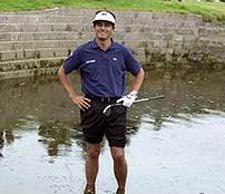
In 1999: In one of the biggest meltdowns in sports history, Jean Van de Velde of France triple-bogeyed the final hole at the British Open, thus forcing a playoff with Paul Lawrie and Justin Leonard at Carnoustie in Scotland. Van de Velde only needed a six on 18 to win. His tee shot went left, his second shot hit the grandstand, his third went into the water (where he actually took off his shoes and rolled up his pants as if to play it out of the water), his next shot chunked into the deeper rough and he barely recovered to “force” the playoff. He never regained his composure, and Lawrie became the first Scot to win on his home turf since 1931. Down 10 shots at the beginning of the rfinal ound, his comeback was the largest in major history. Curtis Strange, covering the tournament for ABC, summed it up perfectly, saying, “this is the dumbest thing I’ve ever seen.”

Also in 1999: On a day when Don Larsen was on hand at Yankee stadium to throw out the first pitch, David Cone went out and mimicked the former Yankee World Series hero by throwing a perfect game. Cone did not allow a single base runner as the Yankees blanked the Montreal Expos 6-0. Cone only threw 88 pitches, 68 of them strikes. It was the 14th perfect game in Major League history and the second in Yankee Stadium in two years (David Wells did it in 1998).

Categories
Cleveland Indians

July 17 in Sports History: Joltin’ Joe’s streak ends

In 1941: Pitchers Al Smith and Jim Bagby, Sr. of the Cleveland Indians combine to halt one of the greatest feats in sports history: Joe DiMaggio’s 56-game hitting streak. In front of 60,000 fans in Cleveland, third baseman Ken Keltner made two great plays to keep the Yankee Clipper off the score sheet. He would start a more modest hitting streak of 17 games the next day, thus hitting safely in 73 of 74 games. DiMaggio hit .409 during the streak, and went on to win the MVP and the World Series for the Yankees. His record has barely been approached, with Pete Rose reaching 44 games in 1978 and Paul Molitor getting to 39 in 1987. baseball-almanac.com

In 1994 In the first-ever championship game to be decided on penalty kicks, Brazil defeated Italy to win the World Cup in front of 94,000 fans at the Rose Bowl in Pasadena, CA. The 0-0 tie capped an otherwise very successful World Cup on American soil. While many believed that the supposedly soccer-ignorant Americans could not hold a tournament of this magnitude, it was the most-attended World Cup ever. Down 3-2 in penalties, Italian superstar Roberto Baggio’s attempt sailed over the crossbar, giving the Brazilians their fourth World Cup.

Categories
Soccer

July 14 in Sports History: The El Salvador – Honduras Soccer War

In 1969: We’ve all heard of soccer riots. But a soccer war? Border tensions were escalating between Honduras and El Salvador for years, and a series of World Cup qualifying matches between the two countries spilled over into violence. Visiting fans were attacked and brutalized in each country. In the second game in El Salvador on June 27, Hondurans were attacked, their flag burned, and a girl committed suicide on the field. While the Soccer War was not directly related to soccer and more about the economic disparity between the two countries, the actions during the game in San Salvador caused the two governments to break off diplomatic relations, thus leading to combat. It was believed that over 6,000 people died in the Soccer War, which lasted only four days.

Categories
MLB General

July 13 in Sports History: the saga of Carl Mays

In 1919: Pitcher Carl Mays of the Boston Red Sox abruptly left the field during a game at Chicago in protest of what he thought was a lack of support in the field from his teammates. He refused to pitch again for the Red Sox. This caused a major controversy in baseball and would set off a course of history that would change the game. First, Mays was traded to the Yankees (right before another famous Boston player), but league president Ban Johnson would not let him play. The Yankees were able to get a court order allowing him to play, thus eroding Johnson’s power. This would be a main reason (along with the Black Sox scandal) for the need for a commissioner the following season. As a member of the Yankees the following year, Mays – a known spitballer and very unpopular player – would throw a pitch that would hit Cleveland’s Ray Chapman, which Chapman would die from. The spitball, although not directly blamed for Chapman’s death, would be outlawed the following year.

In 1999: Ted Williams is honored before the Fenway Park faithful in a touching ceremony before the All-Star Game in Boston. Teddy Ballgame was carted around the field and doffed his cap (finally) to the adoring fans before meeting with the All-Stars from both leagues. Williams, always known as surly with the Boston crowd, is moved to tears by the tribute and thoroughly enjoyed talking hitting with the players. The spontaneous and poignant moment delayed the game’s start by 15 minutes. In the game, Red Sox ace Pedro Martinez struck out the first four batters and five of the six he faced in a 4-1 AL victory. He would become only the second player in All-Star history to win MVP honors in his home park (Sandy Alomar did it in Cleveland in 1997).

Categories
MLB General

July 12 in Sports History: Disco Sucks!

In 1976: Owner Ted Turner of the Atlanta Braves offers perhaps one of the goofiest promotions of all time to fans attending the game versus the Mets. First, 34 couples were married in a ceremony at home plate. Then, Turner held a card for his fledgling Championship Wrestling league on the field; thus the (I guess) appropriately named “Headlocks and Wedlocks” promotion.

In 1979: As strange as Turner’s promotion might have been, it doesn’t hold a candle (or should I say blowtorch?) to a charter member of the Sick Promotions Hall of Fame: Disco Demolition Night at Chicago’s Comiskey Park. The White Sox were playing a doubleheader against the Detroit Tigers, and White Sox owner Bill Veeck encouraged fans to exchange their unwanted disco records for a dollar admission to the game. Fans also brought records into the game and were tossing them like Frisbees. It quickly got ugly, as Chicago DJ Steve Dahl blew up a box of disco records in center field (and tearing a hole in the field). Fans quickly rushed the field, started their own fires, and police in riot gear had to clear the field. The White Sox forfeited the second game of the doubleheader.

Categories
MLB General

July 11 in Sports History: All Star Edition Part 2

In 1939: The first of only three All-Star games ever to be played at Yankee Stadium saw the A.L. defeat the N.L 3-1. Joe Dimaggio homered in the fifth inning to provide the offense. Later that year, New York would become the first team to host an All-Star Game and win the World Series in the same year (they did it again in 1977 and barely lost in 1960).

In 1944: Pittsburgh hosted it’s first All-Star Game at Forbes Field. The N.L. won 7-1, but both rosters lacked the big-name stars of the day as many players were serving in World War II. It was also one of the most poorly attended All-Star Games, with just over 25,000 fans.

In 1967: In Anaheim, CA, the N.L. defeated the A.L. in 15 innings in the longest All-Star Game in history. Played during the height of the last great pitcher’s era, the two teams combined for 30 strikeouts. Tony Perez of the Cincinnati Reds won the game’s MVP award with a solo home run off Catfish Hunter in the 15th inning.

In 1989: Bo Jackson of the Kansas City Royals stole the show with a towering, 448-foott leadoff home run off the first pitch in the bottom of the first inning of the 60th All-Star Game, once again hosted by the Angels in Anaheim. Jackson also doubled, stole third and made a great defensive play to win the MVP award.

In 1995: Pitcher Hideo Nomo of the Los Angeles Dodgers became the first Japanese player to appear in an All-Star Game as he started for the National League at the Ballpark in Arlington, Texas. Despite managing only three hits (and being no-hit through the first six innings), the N.L. scratched out the win with three solo home runs. Jeff Conine of the Florida Marlins hit the game-winner and was named MVP.

Categories
MLB General

July 10 in Sports History: All-Star Game edition


Caption Text

In 1934: Carl Hubbell of the New York Giants and the National League struck out five future Hall of Famers in a row in the second ever All-Star Game in front of his home fans at the Polo Grounds. Hubbell fanned American Leaguers Babe Ruth, Lou Gehrig, Jimmie Foxx, Al Simmons and Joe Cronin consecutively. The AL rallied to win the game 9-7, however.

In 1940: The NL defeated the AL 4-0 in the first shutout in All-Star Game history at Sportsman’s Park in St. Louis . Max West of the Boston Bees (?) hit a three-run homer in the first inning while the Junior Circuit only managed three hits.

In 1945: The All-Star Game to be played at Fenway Park in Boston was cancelled due to travel restrictions during the end of World War II. The Midsummer Classic would return to Fenway the following year.

In 1951: The NL used four home runs to pummel the AL 8-3 at Briggs Stadium (a.k.a. Tiger Stadium) in Detroit. Ralph Kiner of the Pittsburgh Pirates hit a round-tripper for the third straight year.

In 1962: The NL won the first All-Star Game of two to be played that year 3-1 at D.C Stadium, the home of the Washington Senators. Roberto Clemente of the Pirates had three hits, but Maury Wills of the L.A. Dodgers won MVP honors.

In 1984: National League pitchers Fernando Valenzuela of the Dodgers and Dwight Gooden of the N.Y. Mets combined to break Hubbell’s consecutive strikeout record by fanning six straight at San Francisco’s Candlestick Park on the 50th anniversary of Hubbell’s feat. Gooden also was the youngest All-Star ever at the age of 19.

In 1990: In a rain-soaked All-Star Game at Wrigley field, the AL shutout the NL 2-0. Six AL pitchers combined on a two-hitter. Julio Franco (!) of the Texas Rangers drove in both runs and was named MVP.

In 2001: In his final All-Star Game, the soon-to-be-retiring Cal Ripken of the Baltimore Orioles homered to the delight of the Safeco Field crowd in Seattle, leading the AL to a 4-1 victory. The game also featured a classy gesture by Rangers shortstop Alex Rodriguez, who insisted Ripken switch positions with him at third base so Ripken could play short one final time. Although some questioned the pitch (cough-gopher ball) that Chan Ho Park served to Ripken, Ripken received what was believed to be the longest ovation in All-Star history. He and Tony Gwynn were also presented achievement awards by Commissioner Bud Selig during the game.

Categories
MLB General

June 6 in Sports History: The First All-Star Game

In 1933: The first Major League All-Star Game took place in Chicago’s Comiskey Park (and the whole idea was proposed by a sportswriter nonetheless). The American League, featuring Babe Ruth, Lou Gehrig and Jimmie Foxx defeated the National League squad, 4-2. Ruth hit the very first homer in al-star history in the third inning, with a blast into the right field bleachers.


and in 1983
: The 50th Anniversary of the midsummer classic was also held in Comiskey Park. Once again, the AL won, this time a 13-3 rout over the senior circuit. Fred Lynn of the California Angels hit the first grand slam in the game’s history, once again in the third inning.

In 2002: Daryle Ward of the Houston Astros hit PNC Park’s first and only home run into the Allegheny river on the fly (many have bounced in off of the walkway behind the bleachers). Ward’s 479-foot grand slam helped pace the Astros to a 10-2 victory over the Pittsburgh Pirates. The event was significant to me for two reasons. First, I was at the game; and second, Ward would be my neighbor for a brief period while with the Pirates during the 2005 season, before later signing with the Washington Nationals in the offseason. I moved into the apartment next to Ward on July 6 of last year.